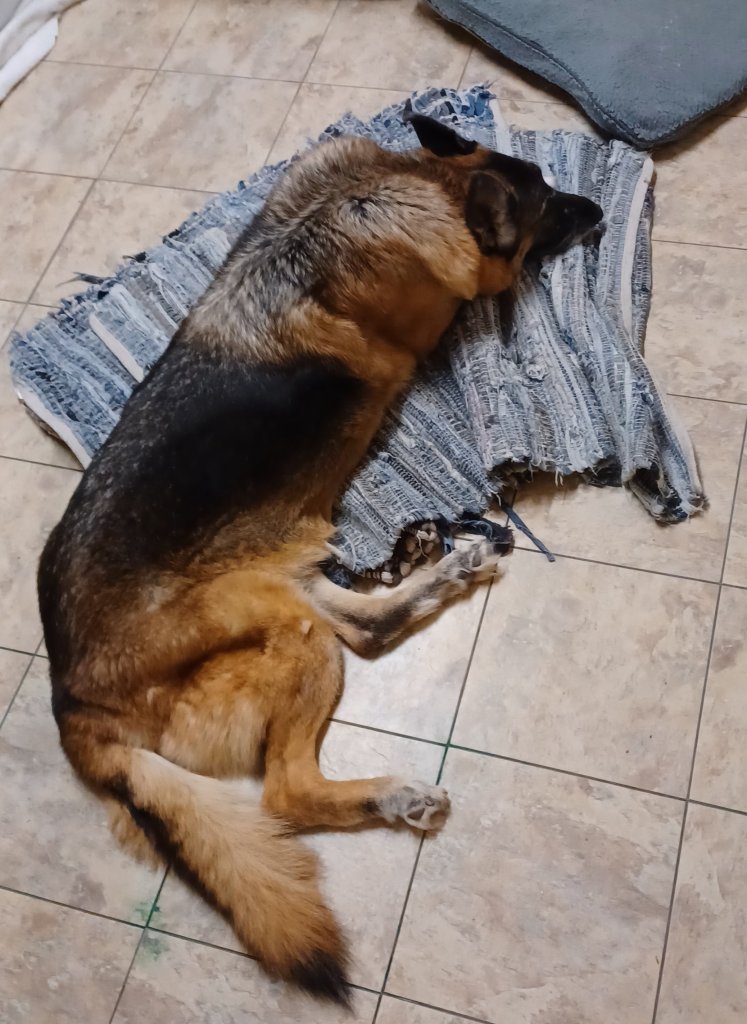
My German Shepherd, Jane, is 10 years old. A couple of weeks before Thanksgiving, she started having some trouble with lameness in her hind legs (especially the left) and sometimes her legs would really sag, and she seemed to have no strength in them. Then, the next day, I would see her trotting effortlessly. I thought she probably had a disc problem, so I gave her Rimadyl, which seemed to help.
On Thanksgiving, after going up and down stairs with no problem, I found her completely paralyzed in the rear. She could not move her back legs at all. However, she could wag her tail and maintained bowel and bladder control. The vet, Dr. Kara Kolster, did multiple x-rays but did not see evidence of a disc rupture. Jane was positive for Lyme disease, although that could have been from long ago past exposure. Dr. Kolster put her on doxycycline, gabapentin, and prednisone. We decided to do supportive care and wait and see, rather than doing very expensive further testing, which would be hard on Jane. Also, I decided that I would not put her through back surgery at her age and with an uncertain outcome.
Stan, my boyfriend, said he would help. Because of my own back issues, I could not constantly lift her to take her outside. I am deeply grateful to him, because without him, I would have had to put her to sleep.
Gradually, Jane has improved to the point that she is supporting weight on her rear legs when standing, and even moves them slightly in a walking motion when her rear is carried in a sling. This is by no means functional yet, but I am really floored by her never give up attitude and desire to move, play, and be near me and her brother Johnny. She has a great appetite and loves to be petted and groomed.
I had myself and all the other dogs tested for Lyme disease. We were all negative.
Based on her very slow improvement and her previous symptoms, along with consultation with a neurologist and radiologist, Dr. Kolster believes Jane has Fibrocartilaginous Embolization (FCE). Here is a link to a description of the condition. https://www.petmd.com/dog/conditions/neurological/fce-fibrocartilaginous-embolism-dogs
There is no known hereditary component to FCE. Jane may not improve to the point of functionality, but we are giving her every chance.
 Shepherd Sight
Poor Jane! I’m so sorry to hear of her problem. Thank goodness for Stan’s help. Melissa Life is short. Surround yourself with good people.
LikeLike